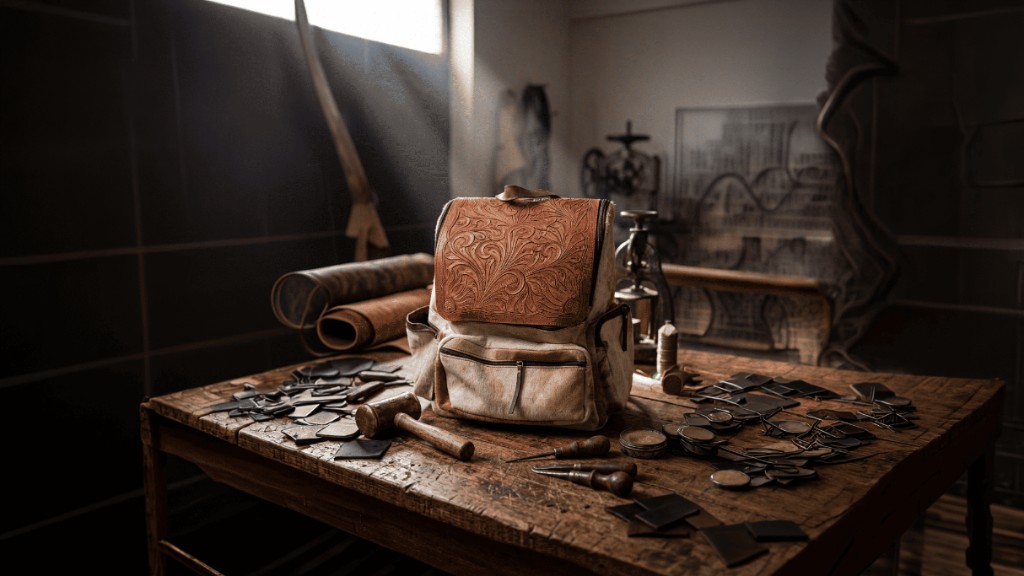
The workshop is the starting point for everything. Raw hides, a workbench worn smooth by years of use, stamps and swivel knives arranged in rows — it looks like a place where time moves differently. And in a sense, it does. Hand-tooled leather craft operates on the timescale of intention, not production.
It Starts With the Right Hide
Before any tool touches leather, the material itself has to be right. HydeKraft uses vegetable-tanned full-grain leather — the same grade used by saddlers and boot makers for generations. Vegetable tanning, done with bark and plant extracts rather than industrial chemicals, produces leather that is firmer, more responsive to tooling, and far more durable over time.
The hide is dampened to the precise point where the fibres relax and open — too dry and the tools won't cut cleanly; too wet and the impressions won't hold. Getting that right is the first skill, and it takes time to develop.
The Swivel Knife: Where Every Design Begins
The swivel knife is the most personal tool in the workshop. Its angled blade rotates freely as the artisan draws it through damp leather, cutting the outlines of floral scrolls, acanthus vines, and geometric borders that define the Western leather tradition.
These cuts are not traced from a template. They are drawn freehand, guided by practice and feel. The depth of the cut, the radius of each curve, the pressure applied at a corner — all of it is a decision made in the moment. No two cuts are exactly the same. That's not a flaw. That's the point.
“It looks like a place where time moves differently.”
Stamping: Raising the Design in Three Dimensions
Once the outline is cut, the artisan uses leather stamping tools — bevelers, camo stamps, pear shaders, veiners — to compress the leather around and beneath the cuts, creating depth and shadow in the pattern. Each stamp is struck with a mallet, one impression at a time.
The process of stamping a single flap — the part you see on the front of a HydeKraft hand-tooled backpack — can take several hours. The pattern has to build coherently: each stamp must relate correctly to the ones around it, building a composition that reads as a whole rather than a collection of marks.
The bench in the workshop is never quiet during this stage. The rhythm of mallet on stamp, repeated hundreds of times, is the sound of a bag being made.
Cutting, Assembling, and Stitching
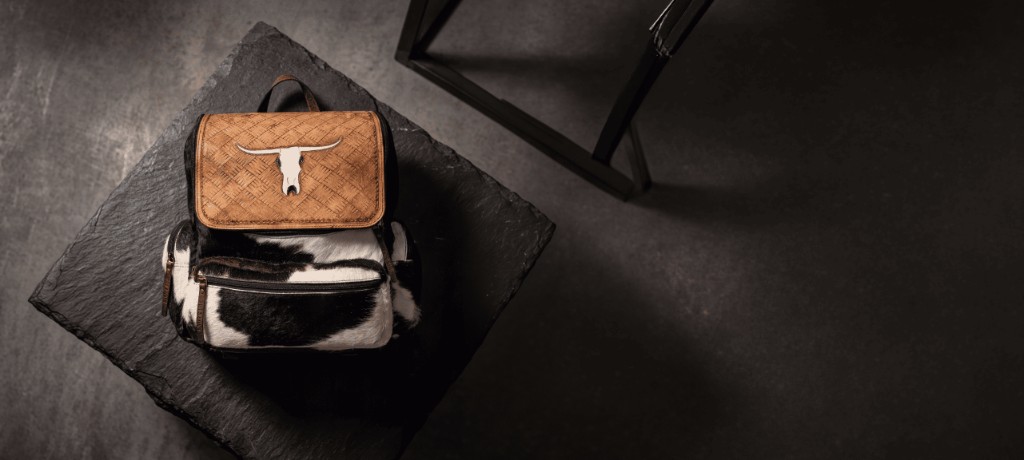
After the tooling is complete and the leather has dried and set, the pieces are cut to final dimensions. This is where the structural integrity of the bag begins to take shape. The body panels, base, straps, and gussets are cut from full-grain leather or natural hair-on hide, depending on the design.
Stitching is done by hand or on a heavy-duty saddle-stitch machine using waxed linen or nylon thread. The saddle stitch — a two-needle technique used in leatherwork for centuries — is considerably stronger than a standard lockstitch. If one thread breaks, the other holds. The bag doesn't unravel.
Every stitch line is checked. Every seam is consistent. This is not the kind of quality control done by camera or algorithm — it's done by eye and hand, which is the only way it can be done properly.
Hardware and Finishing
The final stage of the process is hardware and edge finishing. HydeKraft uses solid antique brass hardware — buckles, rings, and zippers that match the warmth of the leather rather than fighting it. Each piece of hardware is fitted and checked for smooth operation.
The leather edges are burnished — dampened, rubbed with a bone folder or wooden tool until the fibres compress into a smooth, sealed surface. A bag finished this way will not crack or fray at the edges over years of use. It will wear. But wearing is not the same as failing.
Why It Matters That You Know This
We tell you about the process not as a marketing exercise, but because we think it changes the relationship you have with what you carry. When you know a pair of hands spent hours on the flap of your bag — measuring the dampness of the leather, deciding the arc of each knife cut, striking each stamp with considered force — the bag means something different.
A HydeKraft leather backpack is not just a container. It's a record of work. It carries that work forward, getting more characterful as it ages, wearing in rather than wearing out. That's what the workshop exists to make.